Rice straw is bulky, slow to decompose and often burned in the open, which wastes a useful resource and pollutes the air.
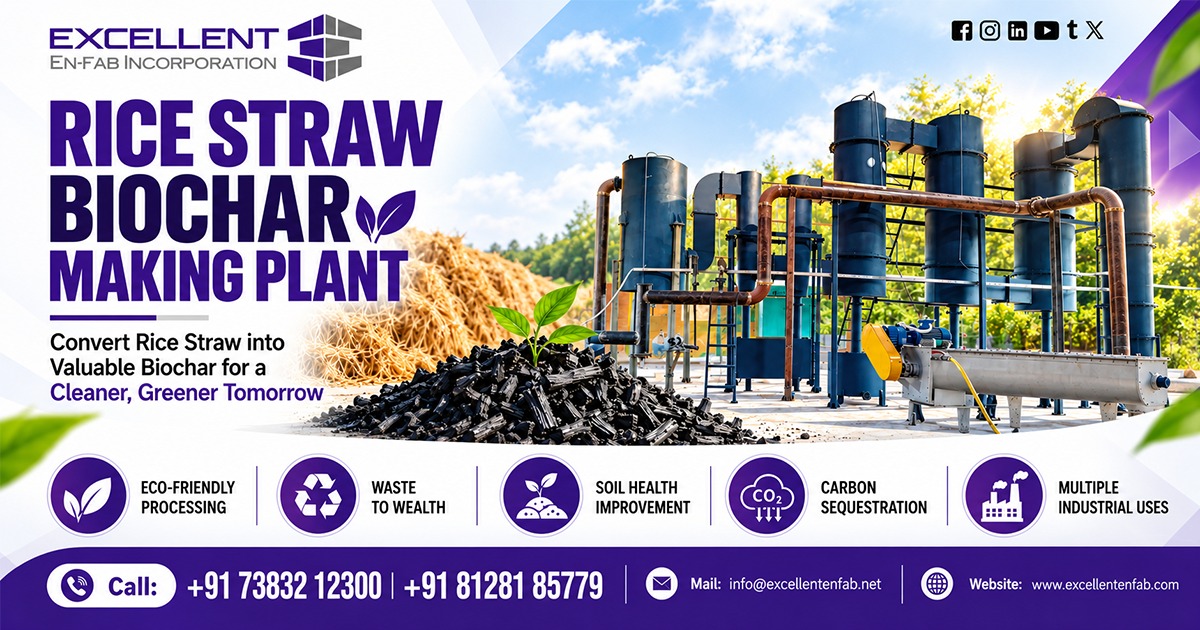
En-Fab Incorporation’s biochar plant converts it through controlled pyrolysis into stable, carbon-rich biochar that improves soil, stores carbon and creates a new revenue stream for Tunisian agribusinesses.
We are based in Ahmedabad, Gujarat, India.
What Is a Rice Straw Biochar Making Plant?
- A pyrolysis system that heats straw at high temperature with limited oxygen
- Produces biochar as the main output, plus syngas and bio-oil as by-products
- Includes feeding, drying, carbonization, cooling, gas cleaning and discharge units
- Available in batch and continuous configurations to match your daily straw volume
Why Tunisia Needs Biochar Technology
- Water-stressed soils: Biochar improves moisture retention and nutrient holding.
- Organic matter demand: It supports soil structure in arid and semi-arid farmland.
- Waste reduction: It cuts open burning and uncontrolled disposal of crop residue.
- Climate goals: Biochar locks carbon in a form that stays in soil for long periods.
- Export and carbon-market potential: Verified biochar can open access to carbon credit programs.
How the Plant Works
- Collection and sizing: Straw is baled, shredded and sorted.
- Drying: Moisture is reduced to improve efficiency.
- Pyrolysis: The reactor carbonizes the straw in an oxygen-limited chamber.
- Syngas recycling: Combustible gas is looped back to heat the reactor, lowering fuel cost.
- Cooling and collection: Biochar is cooled, screened and packed.
Features of En-Fab’s Biochar Plant
- Fuel-efficient design with syngas self-heating
- Low-emission operation with a gas cleaning system
- Robust, corrosion-resistant fabrication for long service life
- PLC-based automation for safe, consistent output
- Scalable capacity and customizable layout
- Handles other residues too, such as wheat straw, olive pruning waste and date palm residue
Applications of Rice Straw Biochar
- Soil conditioner for farms, orchards and greenhouses
- Compost and organic fertilizer enhancer
- Animal feed and bedding additive
- Water and wastewater filtration
- Carbon-credit and ESG projects
Frequently Asked Questions
1. What is a rice straw biochar making plant?
It is a pyrolysis system that converts rice straw into stable, carbon-rich biochar by heating it with little or no oxygen.
2. Can the plant run in Tunisia’s climate and conditions?
Yes. En-Fab designs plants for dry, high-temperature environments, and the straw-drying stage is easy to adapt to local conditions.
3. What feedstocks can it process besides rice straw?
Wheat straw, olive pruning waste, date palm residue, husks, shells and other dry biomass can also be processed.
4. What are the by-products of the plant?
Syngas and bio-oil. Syngas is typically recycled to heat the reactor, which reduces external fuel use.
5. How does biochar help soil?
It improves water retention, aeration and nutrient availability, and it stores carbon for the long term.
6. How do I get a quote or capacity recommendation?
Share your daily straw quantity and location with En-Fab Incorporation to receive a custom proposal.
We Export Rice Straw Biochar Making Plant in Tunisia including locations Tunis, Sfax, Sousse, Kairouan, Métouia, Kebili, Sukrah, Bizerte, Sakiet ed Daier, Gabès, Ariana, Jendouba, Gafsa, Msaken, Medenine, Béja, Kasserine, Monastir, Radès, Hammamet, Tataouine, La Marsa, Ben Arous, Sakiet ez Zit, Zarzis, Ben Gardane, Mahdia, Houmt Souk, Feriana, Fouchana, Le Kram, El Kef, El Hamma, Nabeul, Le Bardo, Djemmal, Korba, Oued Lill, Menzel Temime, Ghardimaou, Midoun, Kelaa Kebira, Moknine, Menzel Bourguiba, Manouba, Kélibia, Rass el Djebel, Ksour Essaf, Bir Ali Ben Khalifa, Sidi Bouzid, El Jem, Tebourba, Ksar Hellal, Douz and many more.
Turn Tunisian farm residue into profitable biochar: request En-Fab Incorporation’s plant proposal and feasibility consultation today.
Contact: +91 73832 12300 | +91 81281 85779
Email Id: Info@excellentenfab.net
Website: www.excellentnfab.com
View Product: Click here