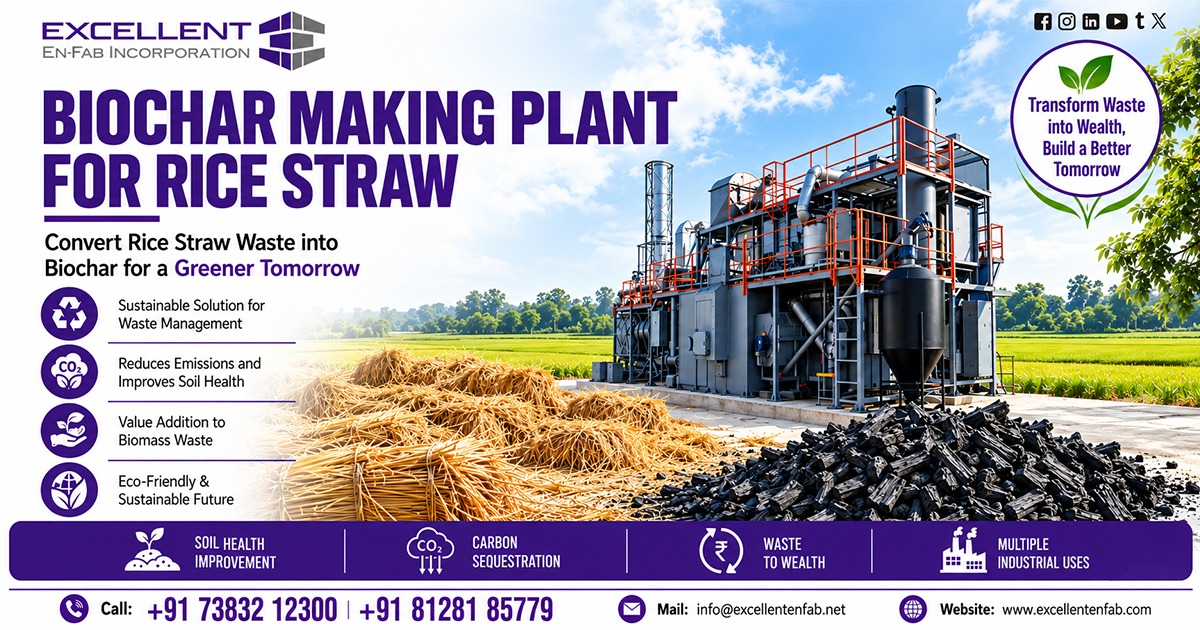
En-Fab Incorporation offers Biochar Making Plant solutions for Rice Straw in Eswatini, helping agricultural businesses, biomass processors, investors, and industrial operators transform rice straw into useful carbon-rich products.
Our plant uses controlled pyrolysis technology to convert agricultural residues into biochar while supporting resource recovery and more sustainable waste management practices.
A Biochar Making Plant is an industrial processing system that converts biomass materials into biochar through controlled heating under limited or oxygen-free conditions.
- Raw Material: Rice straw collected from agricultural fields and processing facilities.
- Processing Technology: Controlled pyrolysis for biomass carbonization.
- Main Product: Carbon-rich biochar.
- Additional Outputs: Depending on the plant configuration, recoverable gases, condensable vapours, and other by-products.
- Application: Agriculture, soil improvement, biomass utilization, and industrial applications.
- Objective: Convert agricultural residues into commercially valuable resources.
Working Process of a Rice Straw Biochar Making Plant
Our biochar production process involves several important stages to convert agricultural biomass into carbon-rich material.
1. Rice Straw Collection and Preparation
- Collect rice straw from farms and agricultural storage facilities.
- Remove unwanted materials such as stones, soil, and other contaminants.
- Prepare the biomass according to the feeding system requirements.
2. Drying and Moisture Reduction
- Reduce excess moisture before processing.
- Maintain suitable feedstock conditions for stable pyrolysis.
- Improve heating efficiency and processing consistency.
3. Biomass Feeding
- Transfer prepared rice straw into the feeding arrangement.
- Maintain a controlled supply of raw material.
- Support consistent material movement through the processing system.
4. Pyrolysis and Carbonization
- Heat rice straw under limited or oxygen-free conditions.
- Break down biomass through thermal decomposition.
- Produce biochar along with process gases and condensable vapours.
5. Gas Recovery and Management
- Collect and manage generated gases through suitable process equipment.
- Depending on the plant configuration, recover usable energy from combustible gases.
- Incorporate appropriate gas treatment and emission-control arrangements.
6. Biochar Cooling and Discharge
- Cool the produced biochar under controlled conditions.
- Prevent unwanted exposure to oxygen during cooling.
- Discharge the finished material for further handling.
7. Packaging and Storage
- Screen and process biochar according to the required application.
- Store the material in suitable conditions.
- Prepare the finished product for agricultural or industrial use.
Applications of Rice Straw Biochar
Biochar produced from rice straw can serve several agricultural and industrial purposes, depending on its quality and processing characteristics.
- Agriculture: Used as a soil amendment to support soil management.
- Soil Improvement: Can help improve soil structure and water retention in suitable soil conditions.
- Composting: Can be incorporated into composting systems to support organic waste management.
- Horticulture: Used in selected growing media and soil blends.
- Nurseries: Can be included in customized soil conditioning mixtures.
- Carbon Sequestration: Suitable biochar can store stable carbon in soil over extended periods.
- Industrial Applications: Certain biochar grades may be used in filtration, adsorbent development, and other material applications after quality testing.
Frequently Asked Questions
Q1: Can rice straw be used to produce biochar?
A1: Yes, rice straw is a suitable agricultural feedstock for biochar production through controlled pyrolysis.
Q2: What technology is used in a rice straw biochar plant?
A2: The plant uses pyrolysis technology, which thermally decomposes biomass under limited or oxygen-free conditions.
Q3: What are the main applications of rice straw biochar?
A3: It can be used in agriculture, soil improvement, composting, horticulture, and selected industrial applications.
Q4: Is the biochar plant suitable for commercial production?
A4: Yes, commercial production is possible with a plant capacity selected according to feedstock availability and market demand.
We Supply Biochar Making Plant for Rice Straw in Eswatini including locations Lobamba, Manzini, Mbabane, Nhlangano, Mhlume, Hluti, Siteki, Piggs Peak, Lavumisa, Hlatikulu, Bulembu, Kwaluseni
and many more.
Transform Rice Straw into Valuable Biochar with En-Fab Incorporation—Contact Our Experts Today for Your Plant Solution.
Contact: +91 73832 12300 | +91 81281 85779
Email Id: Info@excellentenfab.net
Website: www.excellentnfab.com
View Product: Click here