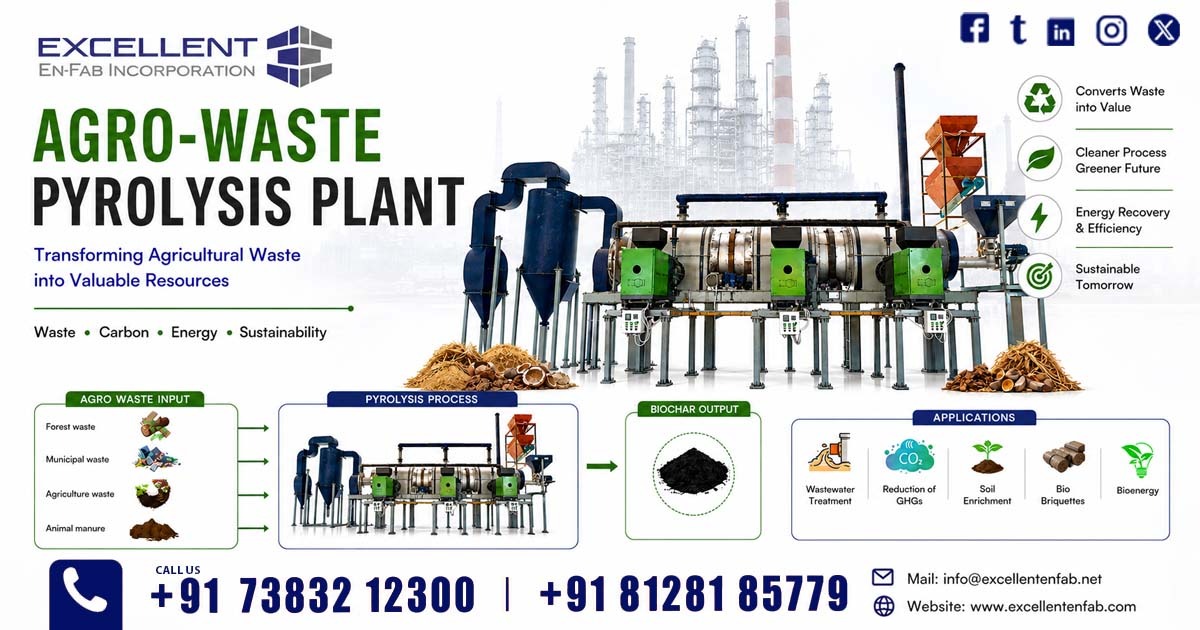
Transform agricultural residues into valuable resources with an advanced Agro-Waste Pyrolysis Plant in Trinidad and Tobago from Excellent En-Fab Incorporation.
Designed to process different types of biomass in a controlled, oxygen-limited environment, the plant converts agro-waste into useful products such as biochar, pyrolysis oil and combustible gas.
This technology offers farms, agro-processing businesses and waste-management operators a practical way to reduce organic waste, recover value and support a more circular economy.
Turn Agricultural Waste into Valuable Products
Trinidad and Tobago produces agricultural and biomass residues that may be difficult or costly to manage.
Instead of allowing this material to accumulate, burn openly or enter landfills, pyrolysis provides an efficient resource-recovery solution.
An agro-waste pyrolysis plant can process suitable materials such as:
- Sugarcane bagasse
- Coconut shells and husks
- Rice husks and straw
- Corn stalks and cobs
- Wood chips and sawdust
- Cocoa and coffee-processing residues
- Fruit stones, seeds and shells
- Other dry agricultural biomass
Feedstock suitability depends on moisture content, particle size and composition. Proper drying and preparation help achieve stable processing and consistent output quality.
How Does an Agro-Waste Pyrolysis Plant Work?
Pyrolysis uses heat to decompose biomass in a low-oxygen environment. The process generally includes:
- Feedstock preparation: Workers sort, dry, and reduce agro-waste to a suitable size.
- Controlled feeding: Prepared biomass is transferred into the pyrolysis reactor.
- Thermal conversion: The reactor heats the material without complete combustion.
- Product recovery: Biochar is collected, while vapours are cooled to recover pyrolysis oil.
- Gas reuse: Non-condensable gas may be reused as process fuel, depending on plant design.
This controlled system creates useful outputs while significantly reducing the original volume of agricultural waste.
Key Outputs of Biomass Pyrolysis
Biochar
Biochar is a stable, carbon-rich solid with potential applications in:
- Soil improvement
- Compost enhancement
- Moisture retention
- Odour management
- Carbon-management projects
- Industrial products, subject to quality requirements
Pyrolysis Oil
The condensed liquid produced during pyrolysis may be used as an industrial fuel or processed further, depending on its properties and applicable regulations.
Combustible Gas
Recovered pyrolysis gas can potentially support reactor heating, helping reduce dependence on external fuel once stable operating conditions are achieved.
Benefits of an Agro-Waste Pyrolysis Plant in Trinidad and Tobago
Efficient Agro-Waste Management
The plant converts bulky agricultural residues into manageable and potentially marketable products.
Reduced Open Burning
Controlled processing provides an alternative to uncontrolled biomass burning, which may create smoke, odour and local air-quality concerns.
Resource Recovery
Instead of treating agro-waste only as a disposal problem, pyrolysis allows businesses to recover biochar, oil and gas from suitable feedstock.
Circular-Economy Support
Pyrolysis connects agriculture, waste management and energy recovery by returning useful materials to productive applications.
Flexible Plant Capacities
Plants can be planned for small, medium or large processing requirements based on feedstock availability, operating schedule and project objectives.
Potential Operating-Fuel Savings
When appropriately designed, recovered pyrolysis gas may be reused within the system to support efficient operation.
Smart Features for Reliable Plant Operation
An agro-waste pyrolysis solution may include:
- Controlled biomass-feeding equipment
- Insulated pyrolysis reactor
- Temperature-monitoring instruments
- Condensation and oil-recovery units
- Gas-cleaning components
- Biochar discharge system
- Air-pollution control equipment
- Safety interlocks and emergency controls
- Manual, semi-automatic or automated operation
- Heat-recovery options based on project requirements
The final configuration should reflect the chosen feedstock, target capacity, desired products and local operating conditions.
Applications Across Trinidad and Tobago
Agro-waste pyrolysis technology can support:
- Farms and agricultural cooperatives
- Sugarcane and food-processing facilities
- Coconut-processing businesses
- Sawmills and wood-product manufacturers
- Municipal waste-management projects
- Biochar producers
- Renewable-energy initiatives
- Research and sustainability programmes
- Industrial operators seeking biomass-recovery solutions
Frequently Asked Questions
1. What is an agro-waste pyrolysis plant?
It is a thermal-processing system that converts agricultural biomass into biochar, pyrolysis oil and gas under low-oxygen conditions.
2. Which agricultural wastes can be processed?
Suitable materials may include bagasse, coconut shells, rice husks, sawdust, crop stalks and other dry biomass.
3. Does the plant produce usable fuel?
Yes. Pyrolysis can produce combustible gas and liquid oil, although their use depends on quality, plant design and regulations.
4. Can plant capacity be customized?
Yes. Capacity and equipment can be selected according to feedstock volume, operating hours and desired outputs.
5. Is feedstock drying necessary?
Usually, yes. Controlling moisture improves thermal efficiency, process stability and the quality of recovered products.
We Supply Agro-Waste Pyrolysis Plant in Trinidad and Tobago including locations Chaguanas, Port of Spain, San Fernando, Arima, Couva, Point Fortin, Princes Town, Arouca, Diego Martin, Morvant, Laventille, Barataria, Sangre Grande, Tunapuna, Scarborough, San Juan, Marabella, Siparia, Carenage, Cunupia, Debe, Rio Claro, Bacolet, Aranguez, Malabar Settlement.
Turn your agricultural waste into clean energy—contact Excellent En-Fab Incorporation today for a pyrolysis plant solution.
Contact: +91 73832 12300 | +91 81281 85779
Email Id: Info@excellentenfab.net
Website: www.excellentnfab.com