Overview
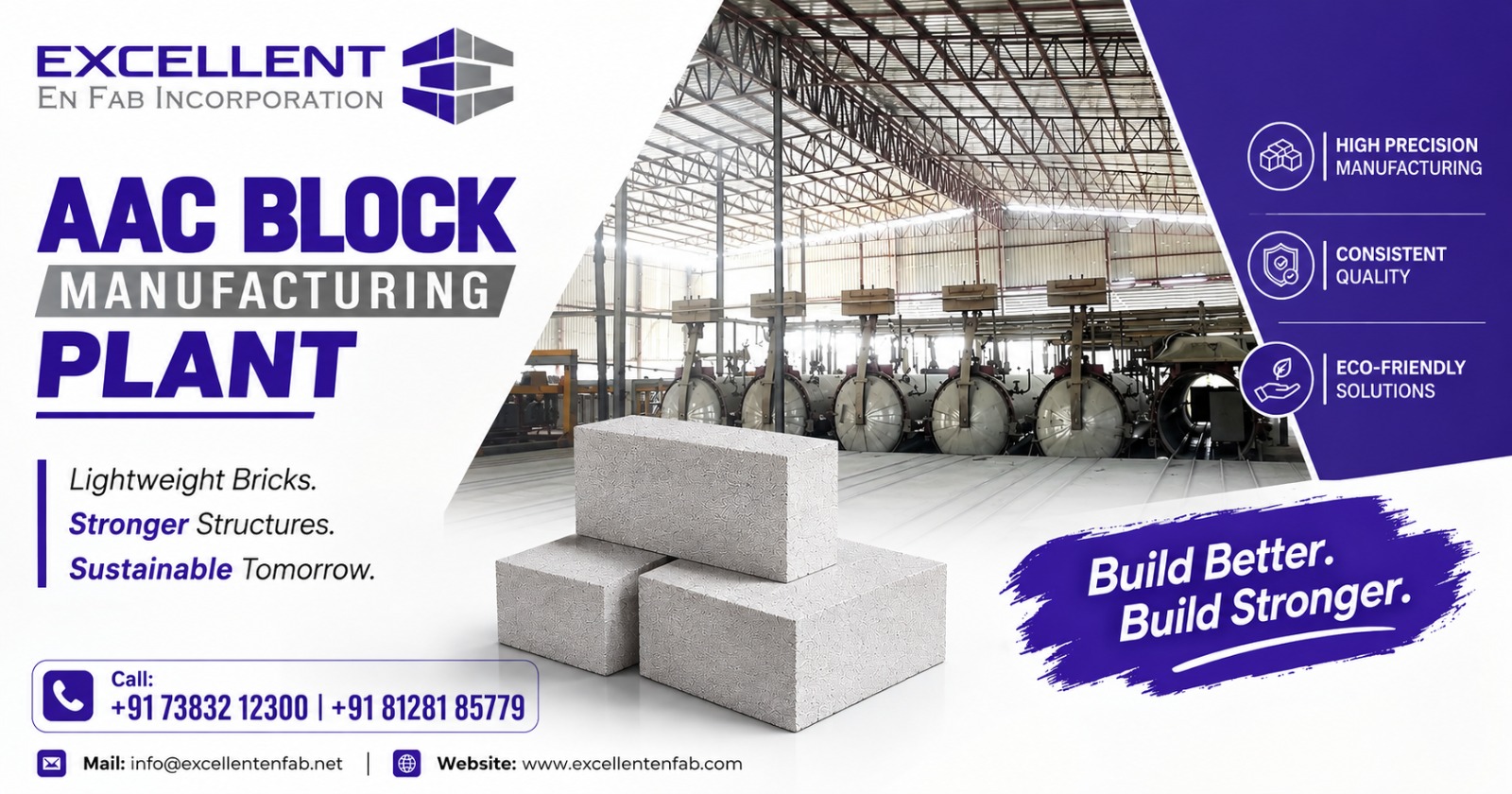
An AAC Block Manufacturing Plant specializes in producing Autoclaved Aerated Concrete (AAC) blocks.
AAC blocks are lightweight, durable, thermally insulating, fire-resistant, and environmentally friendly building materials widely used in modern construction.
Excellent En-Fab Incorporation provides reliable AAC block manufacturing plant solutions designed for efficient production, consistent block quality, optimized material consumption, and dependable plant performance.
Key Benefits
- Lightweight and easy-to-handle construction blocks
- Excellent thermal and sound insulation
- High fire resistance
- Precise dimensions and uniform quality
- Reduced construction time and structural load
- Efficient utilization of raw materials
- Suitable for residential, commercial, and industrial construction
Who Is Excellent En-Fab Incorporation and What Do They Offer?
Excellent En-Fab Incorporation is a manufacturer and supplier of machinery and complete plant solutions for AAC block production.
Their offerings include:
- AAC block manufacturing plants
- AAC block production machinery
- Cutting and moulding systems
- Autoclave systems
- Material preparation and batching equipment
- Mixing and casting equipment
- Handling and conveying systems
- Plant engineering and installation support
- Customized solutions based on production requirements
Their focus is on providing practical, production-oriented solutions that help manufacturers achieve consistent AAC block output and efficient plant operation.
What Are the Main Components of an AAC Block Manufacturing Plant?
An AAC block manufacturing plant generally consists of several interconnected machines and systems:
- Raw Material Handling System: Stores and transfers cement, lime, fly ash or sand, gypsum, and other ingredients.
- Ball Mill/Grinding System: Processes selected raw materials to achieve the required fineness.
- Batching System: Accurately measures individual raw materials according to the production formulation.
- Mixing System: Combines raw materials with water and the required additives to form a homogeneous slurry.
- Moulding and Casting System: Transfers the prepared slurry into moulds for controlled expansion and setting.
- Cutting Machine: Cuts the semi-solid AAC cake into blocks of predetermined dimensions.
- Tilting and Handling Equipment: Supports cake handling and transfer between production stages.
- Autoclave: Uses high-pressure steam curing to develop the required strength and stability of AAC blocks.
- Boiler and Steam System: Supplies steam required for the autoclaving process.
- Conveyors and Transfer Systems: Enable organized movement of materials and blocks throughout the plant.
- Control System: Helps monitor and coordinate plant operations for improved production consistency.
How Does an AAC Block Manufacturing Plant Work?
The AAC block manufacturing process generally follows these stages:
- Raw Material Preparation: Workers prepare cement, lime, fly ash or sand, gypsum, water, and other materials according to the production formulation.
- Grinding: Operators grind applicable raw materials to the required fineness.
- Batching: Operators accurately weigh the materials to maintain the desired mix proportion.
- Mixing: Operators mix the ingredients with water and an expansion agent to create a uniform slurry.
- Casting: Operators pour the slurry into moulds.
- Pre-Curing: The mixture undergoes controlled setting and expands to form a porous cake.
- Cutting: Operators precisely cut the cake into blocks or panels of the required size.
- Autoclaving: Operators steam-cure the cut blocks under controlled pressure and temperature to achieve strength and dimensional stability.
- Handling and Packaging: Finished AAC blocks are removed, inspected, stacked, and prepared for transportation.
This integrated process helps produce lightweight blocks with uniform dimensions and dependable construction performance.
Raw Materials of AAC Block Manufacturing Plant
The major raw materials used in AAC block production can include:
- Fly Ash: Commonly used as a silica-rich ingredient and helps utilize industrial by-products.
- Cement: Acts as a primary binding material.
- Lime: Supports the chemical reaction required for AAC formation.
- Gypsum: Helps regulate the production reaction and contributes to product quality.
- Aluminium Powder/Paste: Produces microscopic air pores through a controlled chemical reaction.
- Water: Enables mixing and supports the chemical and curing processes.
The exact formulation depends on the desired block properties, available raw materials, plant configuration, and applicable production standards.
Application
AAC blocks manufactured using an efficient AAC block manufacturing plant are widely used in:
- Residential buildings
- Commercial complexes
- Industrial buildings
- Warehouses and factories
- High-rise construction
- Partition walls
- External and internal masonry
- Educational institutions
- Hospitals and infrastructure projects
Their lightweight nature can help reduce structural dead load, while their insulation properties can contribute to energy-efficient building designs.
FAQs
1. What is an AAC block manufacturing plant?
It is a complete industrial setup used to produce lightweight Autoclaved Aerated Concrete blocks through mixing, casting, cutting, and autoclaving.
2. What raw materials are used for AAC blocks?
Common materials include fly ash or sand, cement, lime, gypsum, aluminium powder or paste, and water.
3. How are AAC blocks manufactured?
Raw materials are batched, mixed, cast, pre-cured, cut to size, and finally steam-cured inside an autoclave.
4. Why are AAC blocks widely used?
AAC blocks are lightweight, dimensionally accurate, fire-resistant, and provide useful thermal and acoustic insulation.
5. What does Excellent En-Fab Incorporation provide?
Excellent En-Fab Incorporation offers AAC block plant machinery, equipment, plant solutions, and related engineering and installation support.
6. Where are AAC blocks used?
They are commonly used for residential, commercial, industrial, institutional, and infrastructure construction projects.
We Export AAC Block Manufacturing Plant in South Africa including locations Johannesburg, Soweto, Gqeberha, Katlehong, Pretoria, Pietermaritzburg, Durban, Rustenburg, Newcastle, East London, Zebediela, Cape Town, Khayelitsha, Randburg, Roodepoort, Gqeberha, Mitchells Plain, Boksburg, Bloemfontein, Germiston, Centurion, Kimberley, Sandton, Klerksdorp, Bethelsdorp, Kempton Park, Nqutu, Kroonstad, Benoni, George, Potchefstroom, Pinetown, Krugersdorp, Polokwane, Springs, Alberton, Upington.
Choose Excellent En-Fab Incorporation for efficient AAC block manufacturing solutions—contact us today to build your production future.
Contact: +91 73832 12300 | +91 81281 85779
Email Id: Info@excellentenfab.net
Website: www.excellentnfab.com
View Product: Click here