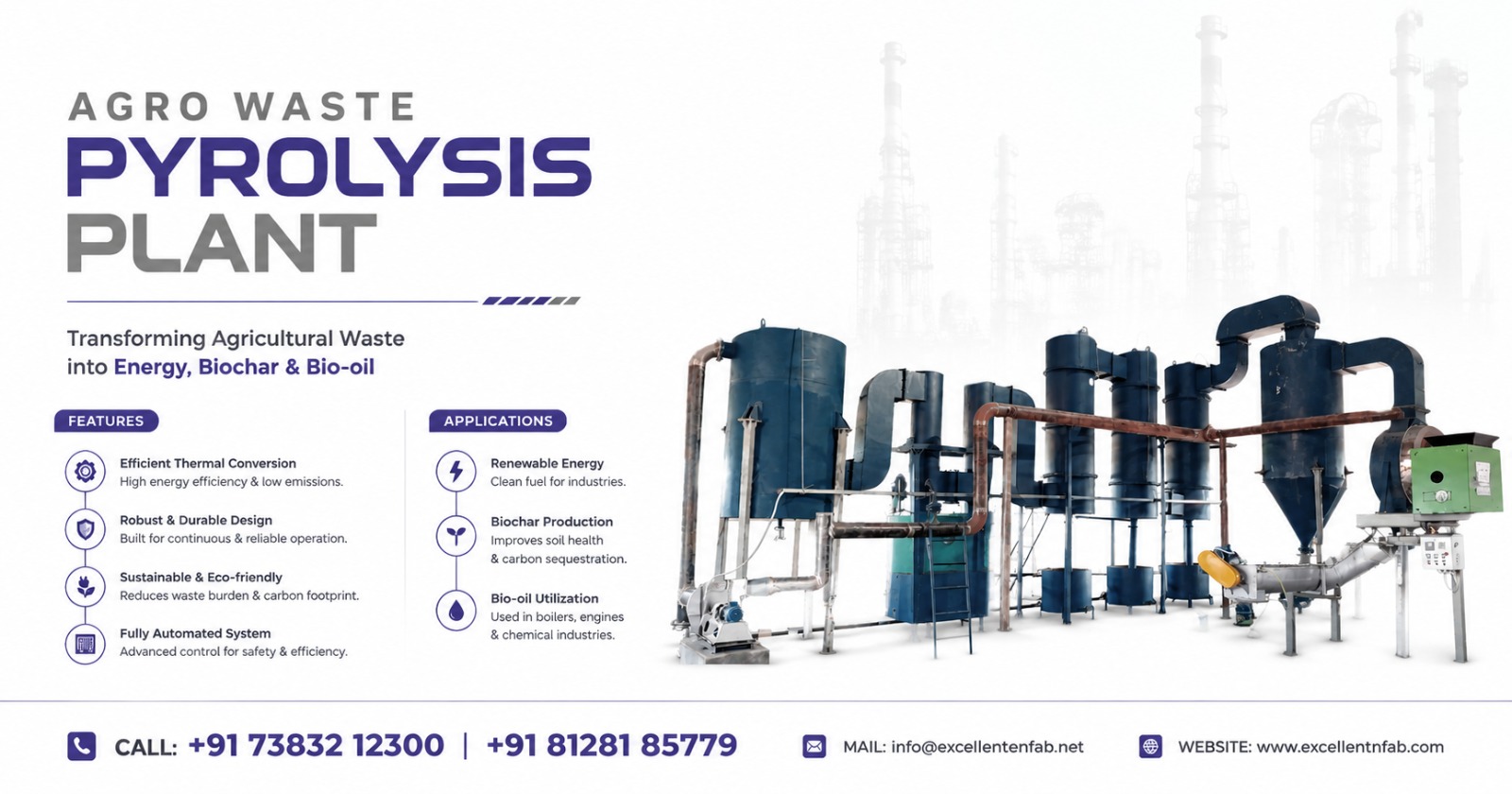
Overview
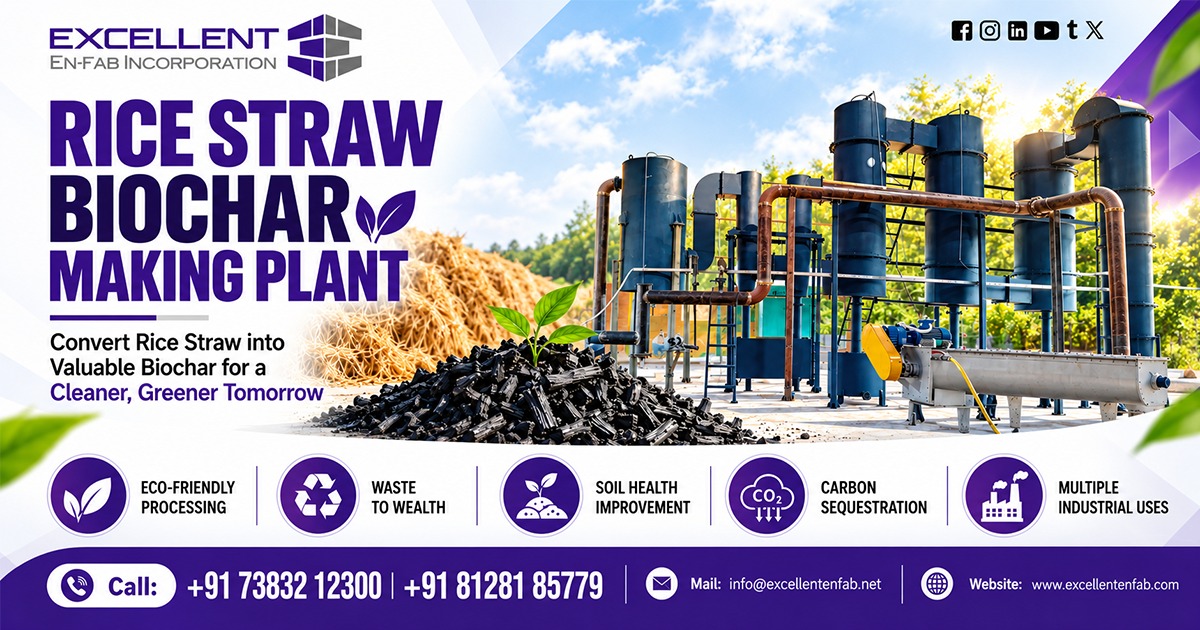
An agro-waste pyrolysis plant converts agricultural residues into biochar, condensable vapours and combustible gases through heating without oxygen. Product yields depend on the feedstock, temperature and process design.
Excellent En-Fab Incorporation manufactures biomass pyrolysis plants and offers agro-waste processing solutions.
For businesses planning an agro-waste pyrolysis plant in Kenya, discussing feedstock availability and desired products is the first step toward selecting suitable equipment.
- Recover useful resources: Turn suitable agricultural residues into usable products.
- Plan around local biomass: Assess collection volumes, seasonal availability and transportation costs.
- Match business requirements: Select a process based on biochar production, energy recovery or other intended outputs.
How Does an Agro-Waste Pyrolysis Plant Work?
- Feedstock preparation: Agricultural residues are sorted, dried and reduced to the required particle size.
- Controlled feeding: Prepared biomass enters the pyrolysis reactor.
- Thermal decomposition: Heat breaks down the biomass without oxygen.
- Product separation: Solid biochar is separated, while condensable vapours can be recovered as bio-oil where suitable equipment is installed.
- Energy recovery: Combustible process gases can provide heat through a properly designed combustion system.
- Biochar handling: The solid product is safely cooled before storage or further processing.
Features of an Agro-Waste Pyrolysis Plant
Discuss these configuration requirements with Excellent En-Fab Incorporation when planning your Kenyan project:
- Feedstock compatibility: Reactor and feeding arrangements matched to the selected agricultural residues.
- Process controls: Temperature and residence-time settings aligned with the target product.
- Biomass preparation: Drying and sizing equipment appropriate for incoming material.
- Product recovery: Biochar collection and, where required, vapour condensation.
- Heat integration: Options for using combustible gases as process fuel.
- Safe operation: Suitable cooling, gas handling, monitoring and emission-control provisions.
Raw Materials for an Agro-Waste Pyrolysis Plant
Potential feedstocks to evaluate for a biomass pyrolysis project in Kenya include:
- Maize residues: Cobs and stalks.
- Rice residues: Husk and straw.
- Sugarcane residues: Bagasse after appropriate drying.
- Coffee residues: Husks from processing.
- Nut residues: Groundnut and macadamia shells.
- Coconut residues: Shells and husks.
- Clean wood residues: Untreated sawdust and wood chips.
Confirm each material through feedstock testing. Moisture, ash, contamination and particle size influence processing requirements and product quality.
Rice husk and wood have been investigated as biochar feedstocks, with results varying by material and processing conditions.
Applications of an Agro-Waste Pyrolysis Plant
- Agricultural residue processing: Manage suitable biomass streams from farms, mills and processing facilities.
- Biochar production: Produce material for evaluated soil-amendment applications; suitability depends on testing and soil conditions.
- Process heat: Recover energy from combustible gases for appropriately integrated equipment.
- Bio-oil recovery: Collect liquid products for compatible industrial uses or further upgrading.
- Further product development: Assess pyrolysis liquids for chemical processing opportunities.
Raw bio-oil is not a direct replacement for conventional vehicle fuel and requires appropriate upgrading for transportation applications.
Frequently Asked Questions About Agro-Waste Pyrolysis Plants
1. What is an agro-waste pyrolysis plant?
It is a system that heats agricultural residues without oxygen to produce biochar, vapours and gases.
2. Which raw materials can Kenyan projects consider?
Maize cobs, rice husks, bagasse, coffee husks and nut shells are candidates, subject to testing.
3. Can the plant process wet agricultural waste?
Wet feedstock generally requires drying to meet the selected plant’s operating requirements.
4. Does every plant produce bio-oil?
Liquid recovery depends on the process design and whether suitable condensation equipment is included.
5. What determines plant cost in Kenya?
Capacity, feedstock preparation, controls, shipping, installation and site requirements influence the total project cost.
6. How can I request a suitable plant proposal?
Share your feedstock type, daily quantity, moisture level, Kenyan site location and intended products with Excellent En-Fab Incorporation.
Agro-Waste Pyrolysis Plant Export Locations in Kenya
We export agro-waste pyrolysis plants to locations across Kenya, including:
Nairobi, Kimunyu, Kagira, Banane, Mombasa, Murang’a, Nakuru, Eldoret, Kisumu, Kikuyu, Dadaab, Kakuma, Lunga-Lunga, Habaswein, Ongata Rongai, Garissa, Kitale, Molo, Kitenkela, Kiambu, Ramu, Kilifi, Kisii, Ngong, Mumias, Nyeri, Kakamega, Wajir, Thika, Lodwar, Athi River, Ukunda, Nandi Hills, Narok, Embu, Machakos, Wundanyi, El Wak, Nyahururu, Bungoma, Malindi, Isiolo, Meru, Webuye, Iten and many more.
Contact Excellent En-Fab Incorporation today to discuss your Kenya agro-waste pyrolysis project and request tailored plant specifications.
Contact: +91 73832 12300 | +91 81281 85779
Email: Info@excellentenfab.net
Website: www.excellentnfab.com
View Product: Click here