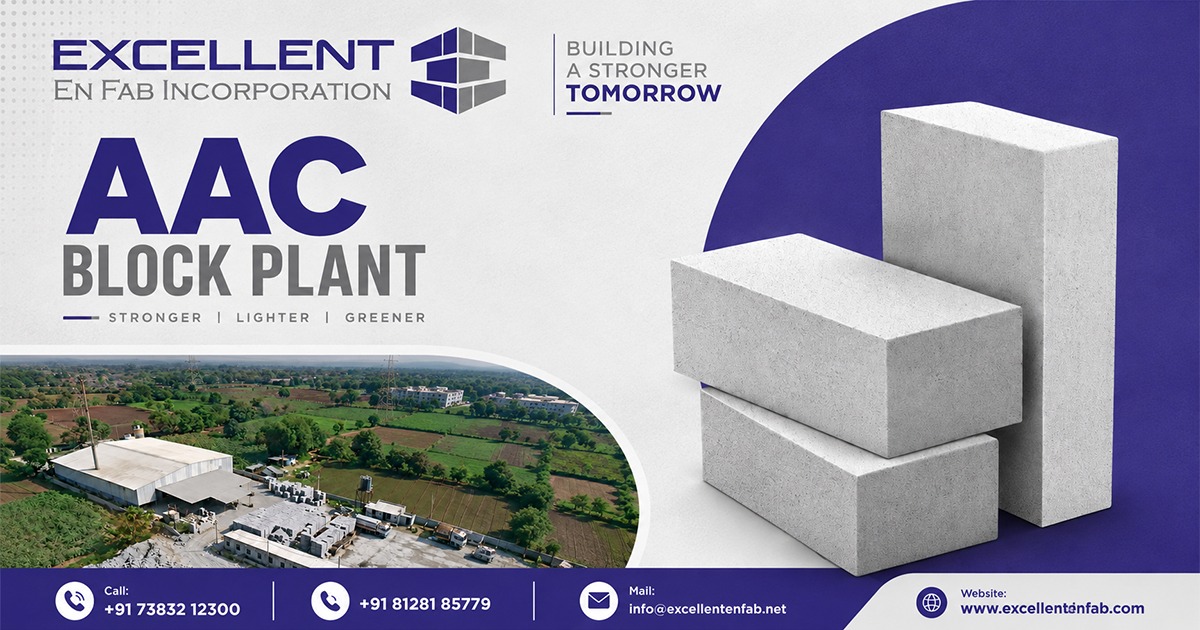
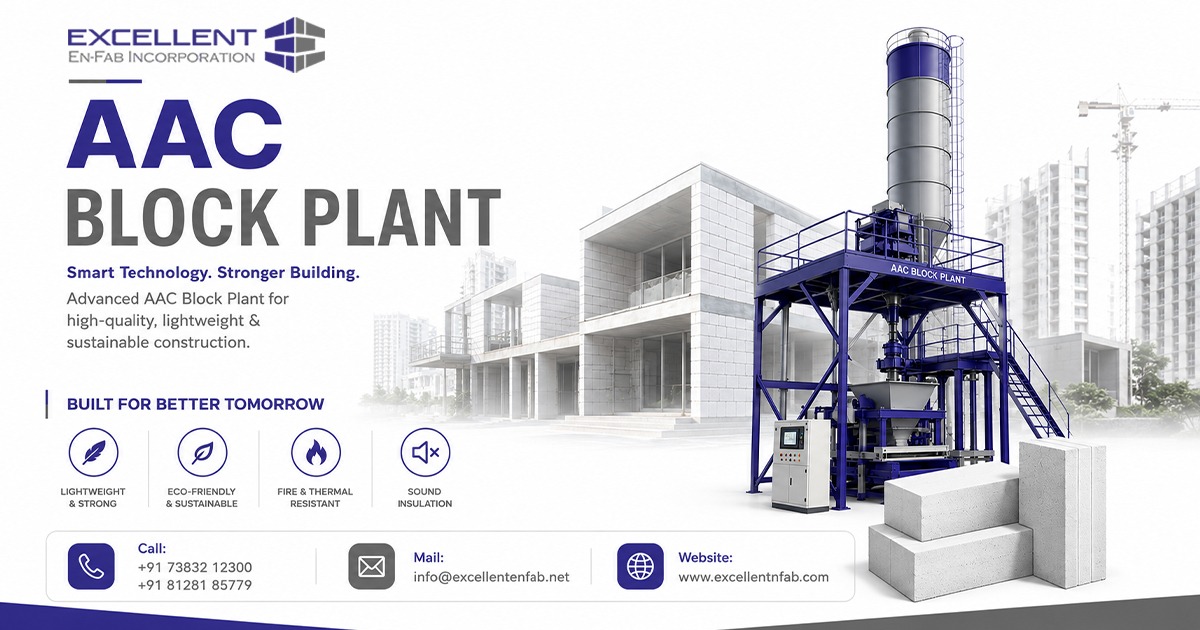
Excellent En-Fab Incorporation is a trusted and reliable manufacturer, supplier and exporter of AAC Block Manufacturing Plant in Kenya.
Our AAC Block Plant Manufacturing unit is based in Ahmedabad, Gujarat, India.
AAC (Autoclaved Aerated Concrete) blocks are a modern, lightweight, and eco-friendly building material widely used in residential, commercial, and industrial construction. Excellent En-Fab Incorporation designs and manufactures advanced AAC Block Manufacturing Plants that deliver consistent quality, high efficiency, and compliance with international engineering standards.
We engineer our AAC plants to support production capacities ranging from 30 m³/day to 750 m³/day, making them suitable for both small-scale and large industrial setups. With precision automation and robust design, our plants ensure smooth production from raw material handling to final block curing.
Work Principle of AAC Block Manufacturing Plant
The AAC block manufacturing process follows a controlled and automated system to ensure uniform quality and strength. The key working stages include:
- Raw Material Preparation: Our system processes fly ash or sand along with cement, lime, and gypsum.
- Batching & Mixing: Accurate proportioning of materials is done using automated batching systems.
- Addition of Aluminum Powder: Acts as a foaming agent to create the porous structure.
- Pouring into Molds: The slurry is poured into steel molds for pre-curing.
- Expansion & Setting: The mixture expands due to chemical reaction.
- Cutting Process: Semi-set blocks are cut into precise sizes using cutting machines.
- Autoclaving (Steam Curing): High-pressure steam curing ensures strength and durability.
This controlled process results in lightweight yet strong AAC blocks with excellent insulation properties.
Why Choose Our AAC Block Manufacturing Plant?
Choosing Excellent En-Fab Incorporation ensures advanced technology and long-term performance benefits:
- High Production Efficiency with optimized automation systems
- Consistent Block Quality due to precise batching and mixing
- Energy Efficient Design reducing operational costs
- Custom Capacity Options from 30 m³/day to 750 m³/day
- Durable Machine Structure designed for long service life
- Low Maintenance Requirements with easy-to-operate systems
- Eco-Friendly Production using industrial waste like fly ash
- International Standard Compliance ensuring global quality benchmarks
Components of AAC Block Manufacturing Plant
An AAC plant consists of several integrated sections working together seamlessly:
- Raw Material Handling System
- Cement silo
- Lime silo
- Gypsum silo
- Fly ash or pond ash silo
- Screening and transfer system
- Batching and Mixing Unit
- Automated weighing system
- High-efficiency mixers
- Water dosing system
- Casting Section
- Moulds and mould handling system
- Pouring and leveling system
- Pre-Curing Area
- Controlled setting chambers
- Cutting Section
- Horizontal and vertical cutting machines
- Precision wire cutting system
- Autoclave Section
- High-pressure steam curing vessels
- Temperature and pressure control systems
- Block Handling & Packaging
- Lifting equipment
- Palletizing and stacking systems
Applications of AAC Blocks
AAC blocks produced by our plants are widely used in:
- Residential buildings and apartments
- Commercial complexes and offices
- Industrial structures and warehouses
- Load-bearing and non-load-bearing walls
- High-rise construction projects
- Partition walls and infill panels
They are preferred for their lightweight structure, thermal insulation, fire resistance, and soundproofing qualities.
FAQs
Q1. What is the production capacity of your AAC Block Plant?
Our AAC plants are available in capacities ranging from 30 m³/day to 750 m³/day depending on project requirements.
Q2. What raw materials are used in AAC block manufacturing?
The main raw materials include fly ash (or sand), cement, lime, gypsum, and aluminum powder.
Q3. Is the AAC plant fully automated?
Yes, our plants are designed with advanced automation systems for batching, mixing, cutting, and curing processes.
Q4. Are AAC blocks environmentally friendly?
Yes, AAC blocks are eco-friendly as they utilize industrial waste materials like fly ash and reduce construction carbon footprint.
Q5. What makes your AAC plant different from others?
Our plants offer high precision engineering, energy efficiency, durability, and customizable capacity options with international quality standards.
We export AAC Block Manufacturing Plant in Kenya including locations in Naragoi, Bungoma, Dadaab, Eldoret, Killfi, Kisil, Lamu, Litein, Lodwar, Lokichoggio,
Mombasa, Moyale, Ruiru, Voi, Mumias, Nairobi, Nanyuki, Narok, Wajir, Watamu, Webuye, Wote, Wundanyi and many more.
For inquiries or more details, kindly reach out to our team.
Contact: +91 73832 12300 | +91 81281 85779
Email Id: Info@excellentenfab.net
View Product: Click here